
How to Build a Dirt Sprint Exacta: A Skinny Ticket Using TJR, Value, and PFIG

How do you build a selective dirt-sprint exacta? See the TJR, Value, and PFIG screen, its historical results, and why a skinny ticket matters.
By Jeff Bessa, founder of Charting Horse Value · November 17, 2026 · Wagering Strategy
How can you build a selective exacta in a dirt sprint? Start with a race where CHV's Horizontal Exotic Score (HxS) is at least 3.0 and the conditions are clean. Put the top Trainer Jockey Rating (TJR) horse on top only if its Value (VAL) is at least +2. Put the top Performance Figure (PFIG) horse underneath, including every runner tied for the top PFIG rank. Never pair the top horse with itself; pass when no different top-PFIG horse remains. The TJR/Value horse must finish first and a top-PFIG horse second.
The appeal is its discipline. It asks for a race where the favorite may be vulnerable, a top horse with a connection signal and a price signal, and a different runner with a strong performance figure for second. It does not ask you to cover every plausible finishing order.
The dirt-sprint screen, step by step
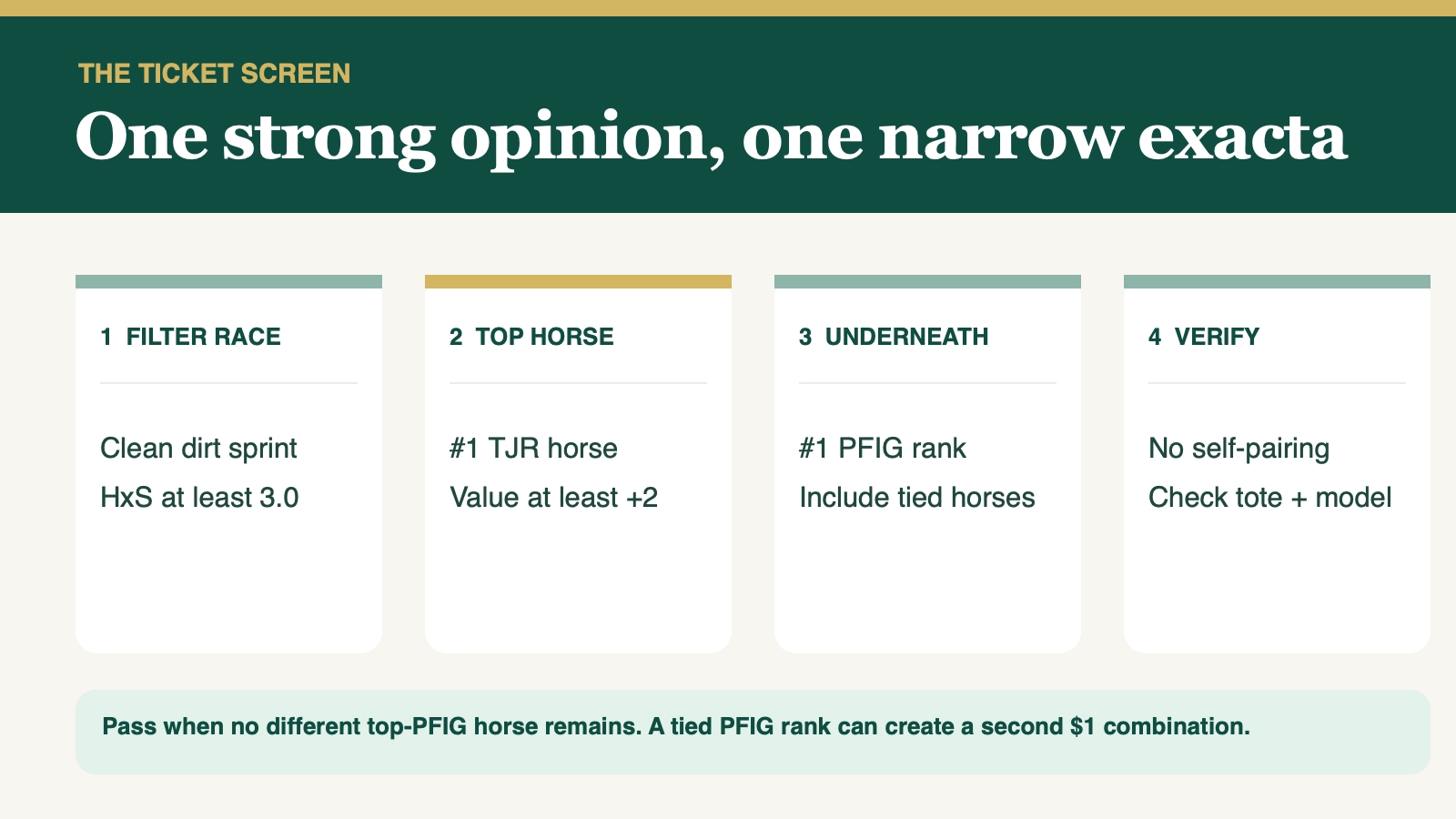
- Filter the race. Use clean-condition Thoroughbred dirt sprints with HxS ≥3.0. CHV's Glossary describes HxS as a 0–5 guide to races where favorites may be beatable in exotic wagers. It is a race-selection signal, not a promise that a favorite will lose.
- Choose the horse on top. Find the top TJR horse and require VAL ≥+2. TJR draws on trainer and jockey factors. Value compares CHV's modeled win probability with its adjusted morning line; requiring positive Value brings both the model's chance estimate and the offered morning-line price into the selection.
- Choose underneath. Use every horse tied for the top PFIG rank. PFIG is CHV's projected performance figure, reflecting recent performance and class. Exclude the TJR horse from underneath; if that leaves no horse, pass. An exacta cannot pair a horse with itself.
- Check the live ticket. Confirm scratches, surface, field, probable exacta payout, and the rest of the model before betting. A qualifying screen is a prompt to handicap, not a blind-bet command.
What did the narrow screen return?
The supplied review reports 794 qualifying races, 811 $1 exacta bets, and 58 hits. The bet count is slightly higher than the race count because tied top-PFIG horses were included underneath. The hit rate is 7.3% of qualifying races and the combined ROI is +27.2%. Only about 6% of all races met the screen. ROI is net profit divided by total amount staked; it includes the cost of losing tickets.
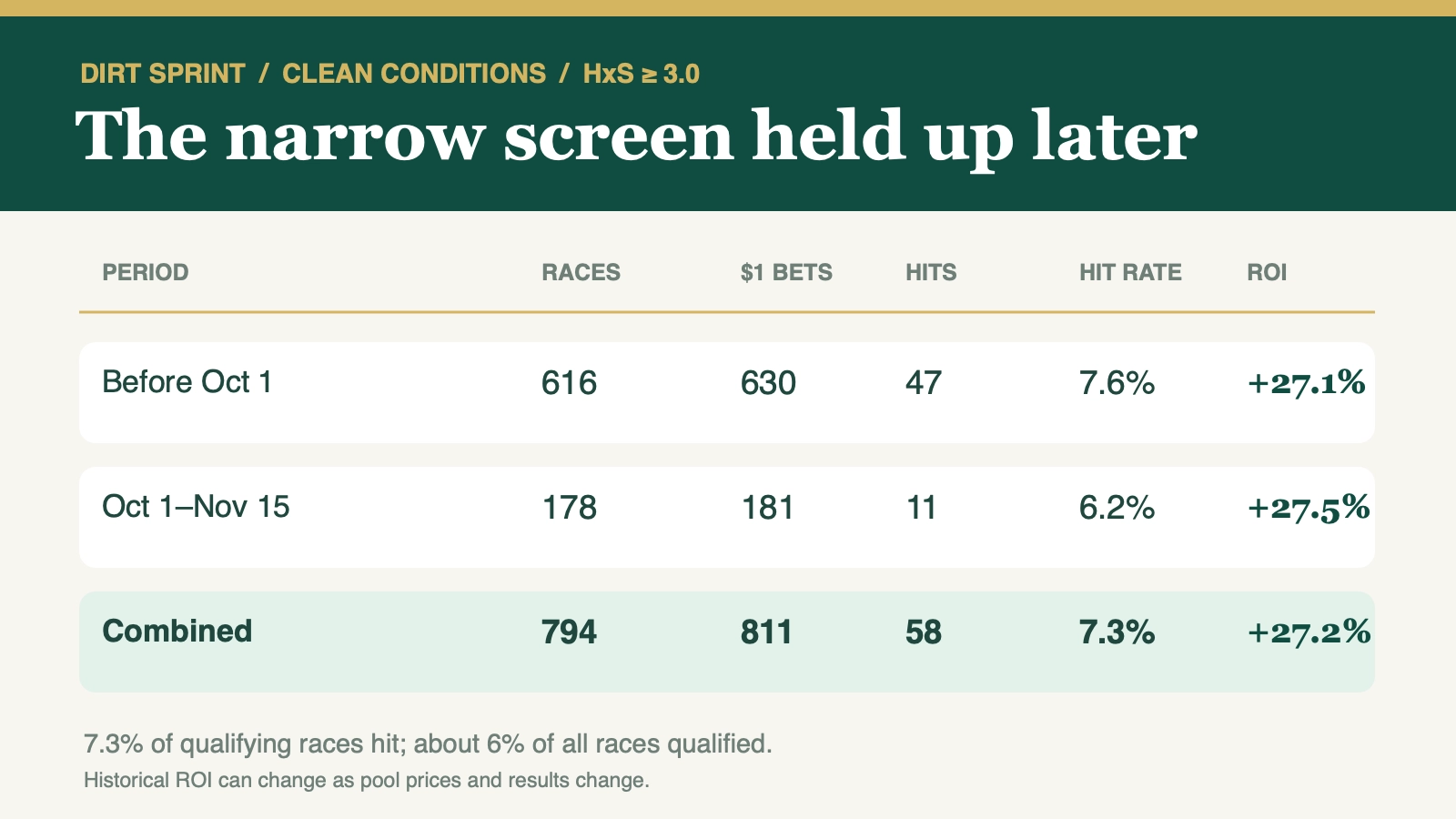
| Period | Qualifying races | $1 bets | Hits | Hit rate | ROI |
|---|---|---|---|---|---|
| Before October 1 | 616 | 630 | 47 | 7.6% | +27.1% |
| October 1–November 15 | 178 | 181 | 11 | 6.2% | +27.5% |
| Combined | 794 | 811 | 58 | 7.3% | +27.2% |
The later period was held out from the earlier review, and its +27.5% ROI is encouraging. It still contains only 11 winning exactas, so a few payouts can move the percentage sharply. A 7.3% hit rate also means long losing stretches are normal. The result supports further testing and selective use; it does not establish a durable edge in every future pool.
Why the Value requirement matters
The top TJR horse is a connection-based choice. The Value gate adds a different question: Does the modeled chance justify a better price than the adjusted morning line implies? A top TJR horse whose price is too short fails this particular screen. The top PFIG horse supplies a separate ability signal underneath. These factors complement one another, but the rule's historical ROI alone cannot prove which component created the return.
The race filter matters too. A high HxS score identifies a race where CHV sees a better chance to beat a favorite. That gives an exacta centered on a value horse more room to pay, while still requiring a correct first-and-second finish. Read the Glossary for the underlying factor definitions.
A broader exacta framework
What if you want a rule that appears more often? Across all distances and surfaces, keep HxS ≥3.0, a clean-condition race, and the top TJR horse with VAL ≥+2 on top. Underneath, choose one different horse in this order: top PFIG; if that is the TJR horse, the Bottom Line Win Bet; if that also duplicates the top horse, the highest remaining modeled win-probability (W%) horse. Unlike the dirt-sprint screen, this version finds an alternate horse instead of passing.
This broader rule qualified in roughly 16% of all races and produced 125 hits in 2,007 $1 straight exactas: a 6.2% hit rate and +5.5% ROI overall. Top PFIG supplied the underneath horse in 1,550 races, the Bottom Line Win Bet in 61, and the W% fallback in 396.
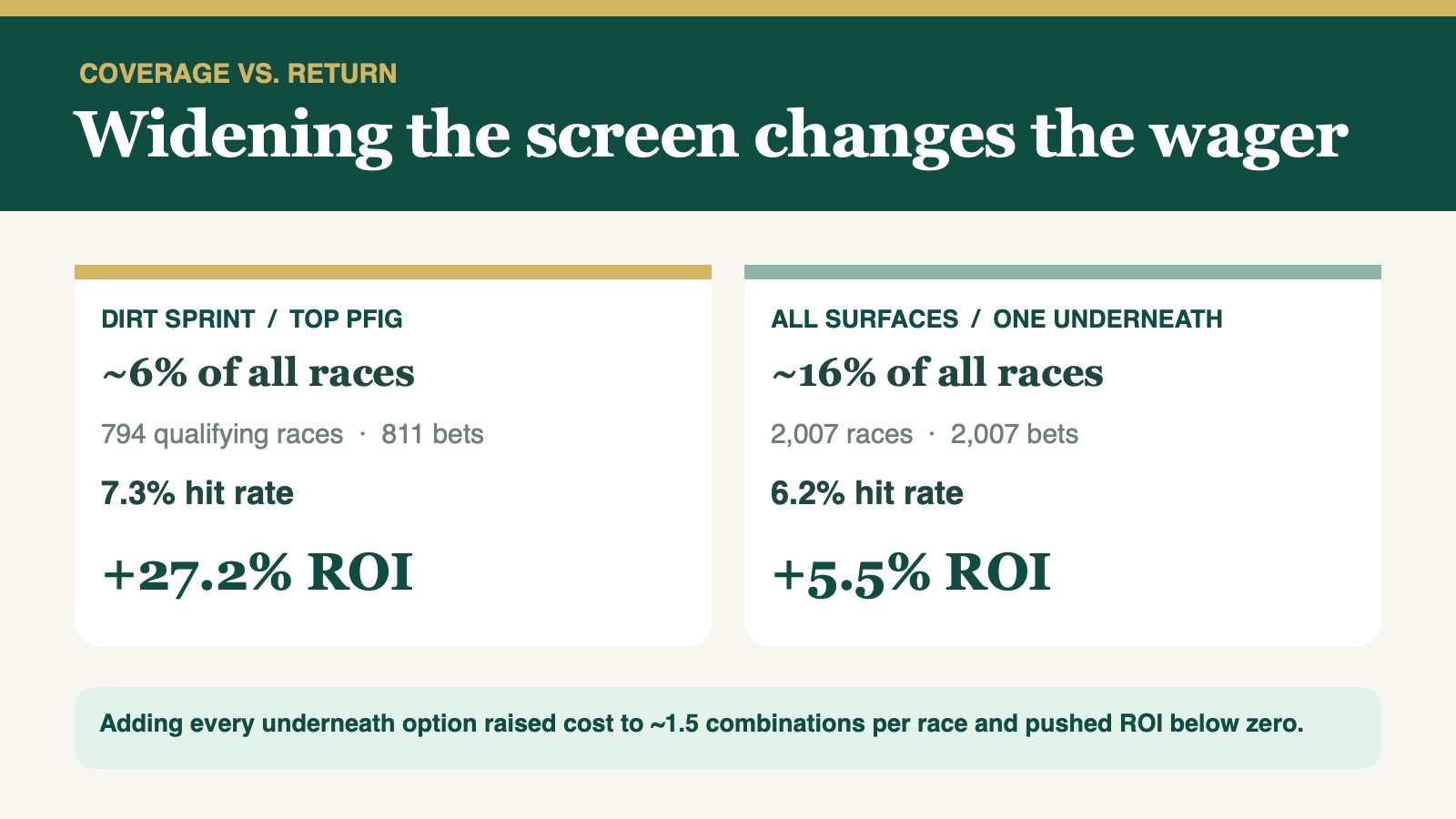
| Broader screen | $1 bets | Hits | Hit rate | ROI |
|---|---|---|---|---|
| All distances and surfaces | 2,007 | 125 | 6.2% | +5.5% |
That positive full-sample ROI is much thinner than the dirt-sprint result. It offers a useful way to structure an opinion across more races, but the dirt-sprint screen remains the stronger candidate for a wagering practice. Adding all three possible underneath horses instead of choosing one raised the average ticket to about 1.5 combinations per race and turned ROI negative in the supplied comparison. Extra coverage has a real price.
Keep the stake as selective as the ticket
The low hit rate calls for a smaller stake than a conventional win bet. As a rough exposure example, a bettor comfortable with $20 on a horse with a 25% win chance might cap a 7.3% hit-rate exacta at about $6 if the expected value and bankroll assumptions are comparable. That $6 is a budgeting illustration, not a mathematically equivalent risk or a recommended bet size for every player. A run of misses can be long, and the exacta's payout is uncertain until the pool closes.
Exacta probables are visible before the race, and pari-mutuel payouts change as money enters the pool. Sophisticated bettors, including computer-assisted wagering (CAW) teams, can react to that information; this review does not measure how much value they may remove from a particular exacta. We will examine trifectas next, where a third finishing position adds complexity and the bettor generally has less direct pre-race guidance on a specific combination's payout. Different takeout and larger ticket costs must be considered there as well. Keeneland's wagering guide explains pool pricing, CAW participation, wager minimums, and takeout.
Use the screen, then handicap the race
The narrow dirt-sprint ticket is our first choice from these tests, not a blind-betting system. Check the final field and conditions, compare live odds and exacta probables with your own price requirement, inspect other model factors and contenders, and count the ticket cost before wagering. Pass when the horse, price, or pool does not support the bet. A historically profitable screen can stop working; wager only what you can afford to lose.
Explore the CHV handicapping app, review the Glossary, and read the Breeders' Cup Saturday exacta analysis for another example of how ticket structure changes cost and coverage.