
The Daily Double looks simple. Pick the winner of one race, pick the winner of the next, and connect them. But simplicity of structure does not mean simplicity of decision.
The first question should not be, "Which two horses do I like?" It should be, "Is this a Daily Double sequence worth betting at all?"
To answer that, I studied 8,065 usable Thoroughbred Daily Double sequences in the Charting Horse Value results database.
The results changed the way I look at this wager.
The baseline
I started with the most natural model-based approach: play the horse with the highest modeled W% in both legs.
| Baseline | Sequences | Hit Rate | ROI |
|---|---|---|---|
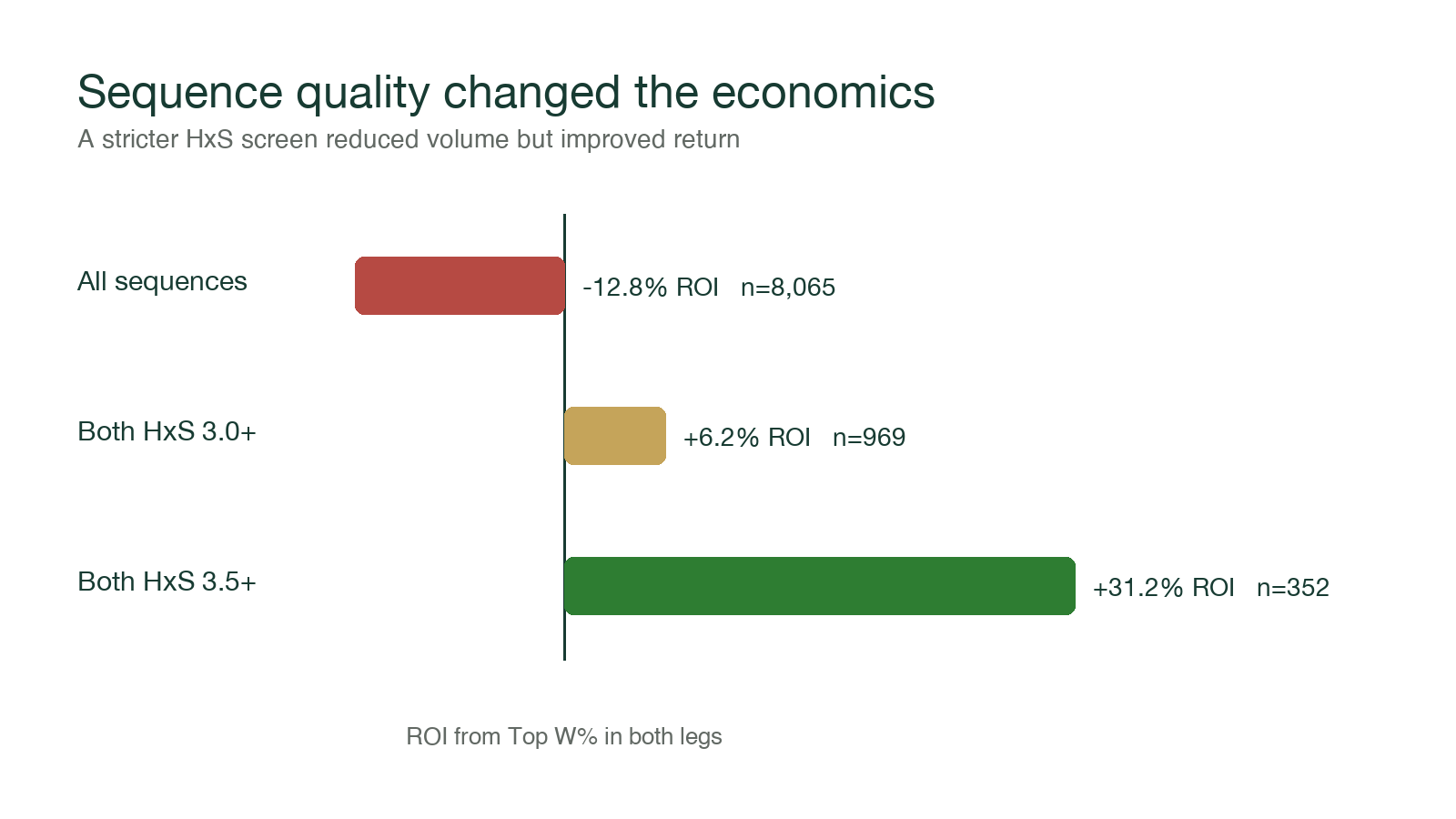
| Top W% in both legs | 8,065 | 11.8% | -12.8% |
The ticket hit often enough to feel respectable. It still lost nearly 13 cents per dollar wagered.
That distinction matters. A strategy can cash regularly and still be a poor bet if the winning combinations are too obvious and the payouts are too short. Hit rate measures frequency. ROI measures whether the price justified the risk.
What HxS measures
Charting Horse Value assigns every applicable race a Horizontal Target Score, abbreviated HxS, on a 0-to-5 scale. HxS does not select a horse. It evaluates whether the race has the ingredients that can make a horizontal wager attractive.
HxS considers three ideas:
- Favorite vulnerability. How strong is the morning-line favorite according to CHV's adjusted win probability, and where does that horse rank?
- Outsider strength. How much combined win probability belongs to the two strongest horses outside the top three in adjusted morning-line odds?
- Price potential. What kind of adjusted morning-line price do those credible outsiders offer?
A higher HxS says the race has a more attractive balance of vulnerability, competition, and potential price. It does not say the race is easy.
Target the sequence before choosing the horses
Requiring both races to have HxS of at least 3.0 reduced the sample from 8,065 sequences to 969, about 12% of the original menu.
Using the same top-W% horse in both legs now produced:
| Sequence Screen | Sequences | Hit Rate | ROI | Early ROI | Holdout ROI |
|---|---|---|---|---|---|
| Both HxS 3.0+ and Top W% in both legs | 969 | 6.7% | +6.2% | +3.4% | +9.2% |
The hit rate fell, but ROI crossed into positive territory. We stopped asking the model to cash the most doubles and started asking it to find doubles worth cashing.
Why calculate holdout ROI
The first 4,351 sequences formed the early sample. The later 3,714 sequences, beginning August 1, formed the holdout.
The early sample helps us discover an idea. The holdout asks whether that idea continued working on later races. A strong early ROI can be exciting, but it can also reflect luck or a rule tailored too closely to the data that created it. Positive holdout ROI gives us more confidence that the relationship persisted rather than disappearing immediately.
It is not a guarantee of future profit. It is a basic defense against fooling ourselves.
Three warning signs
Several segments demonstrated why hit rate alone cannot guide a Daily Double wager.
Low minimum HxS
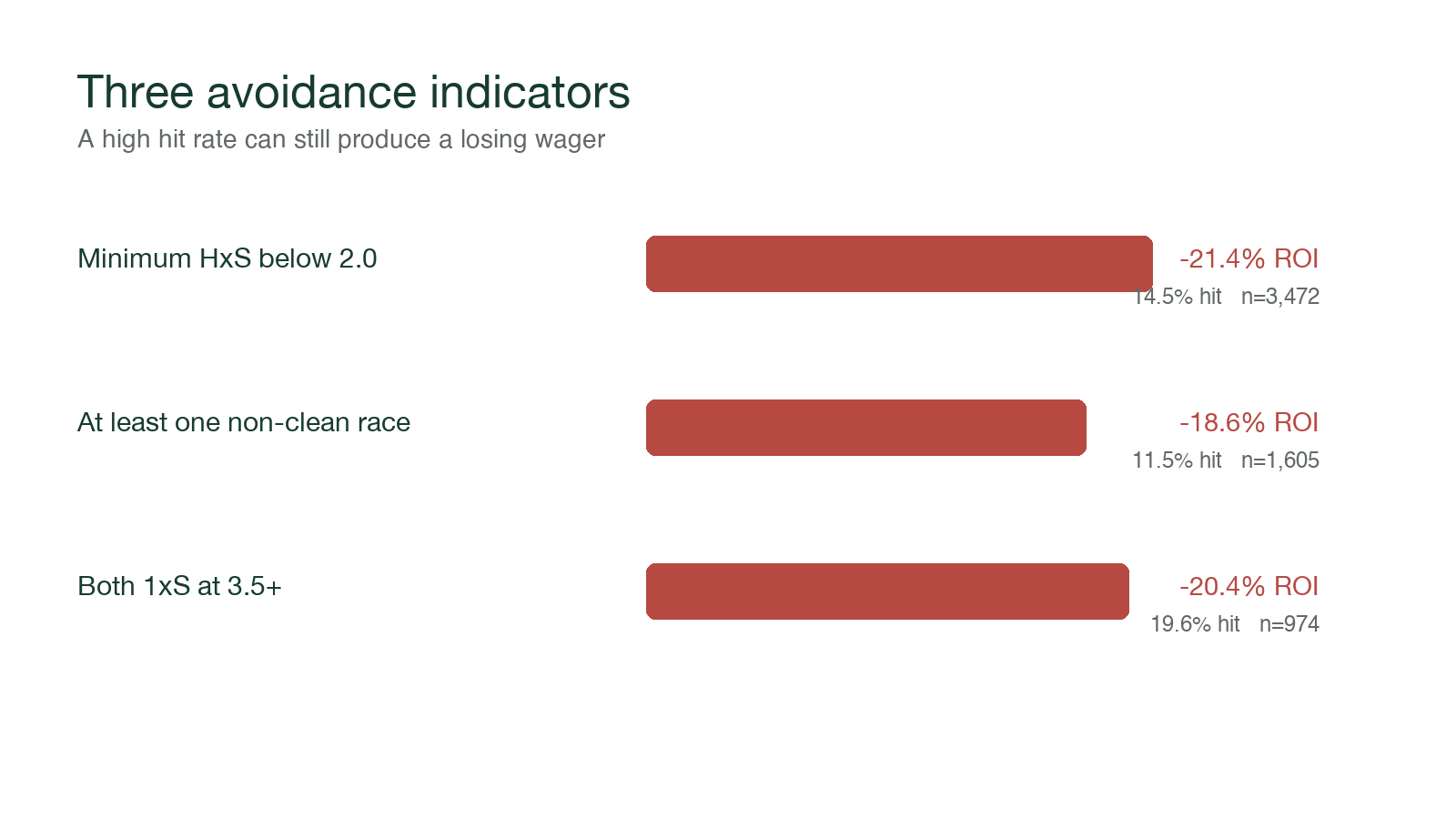
A Daily Double is only as attractive as its weaker leg. When the minimum HxS fell below 2.0, the baseline ticket cashed 14.5% of the time but lost 21.4% of every dollar wagered.
At least one non-clean race
Sequences containing a non-clean race returned -18.6%. Weather, changing surfaces, and uncertain footing introduce another layer of variability. Even if we think we understand the adjustment, the market may not reward us for accepting it.
Both races with high 1xS
The Single Score, or 1xS, measures how suitable a race may be for leaning on one primary horse. When both races had 1xS of at least 3.5, the top-W% double hit an impressive 19.6% of the time. ROI was still -20.4%.
Why? Two obvious singles make the sequence easier for everyone. The public finds the same horses, and the payoff compresses.
That does not make 1xS unhelpful. It makes it more useful as an anchor tool in longer serial wagers, where a reliable single can control ticket cost while other legs create separation. In the Daily Double, two strong singles can leave too little price.
Choosing the horses
Once HxS identified the sequences, I tested different ways to select the horses.
Within the HxS 3.0+ target group:
| Horse Selection | Hit Rate | ROI | Early ROI | Holdout ROI |
|---|---|---|---|---|
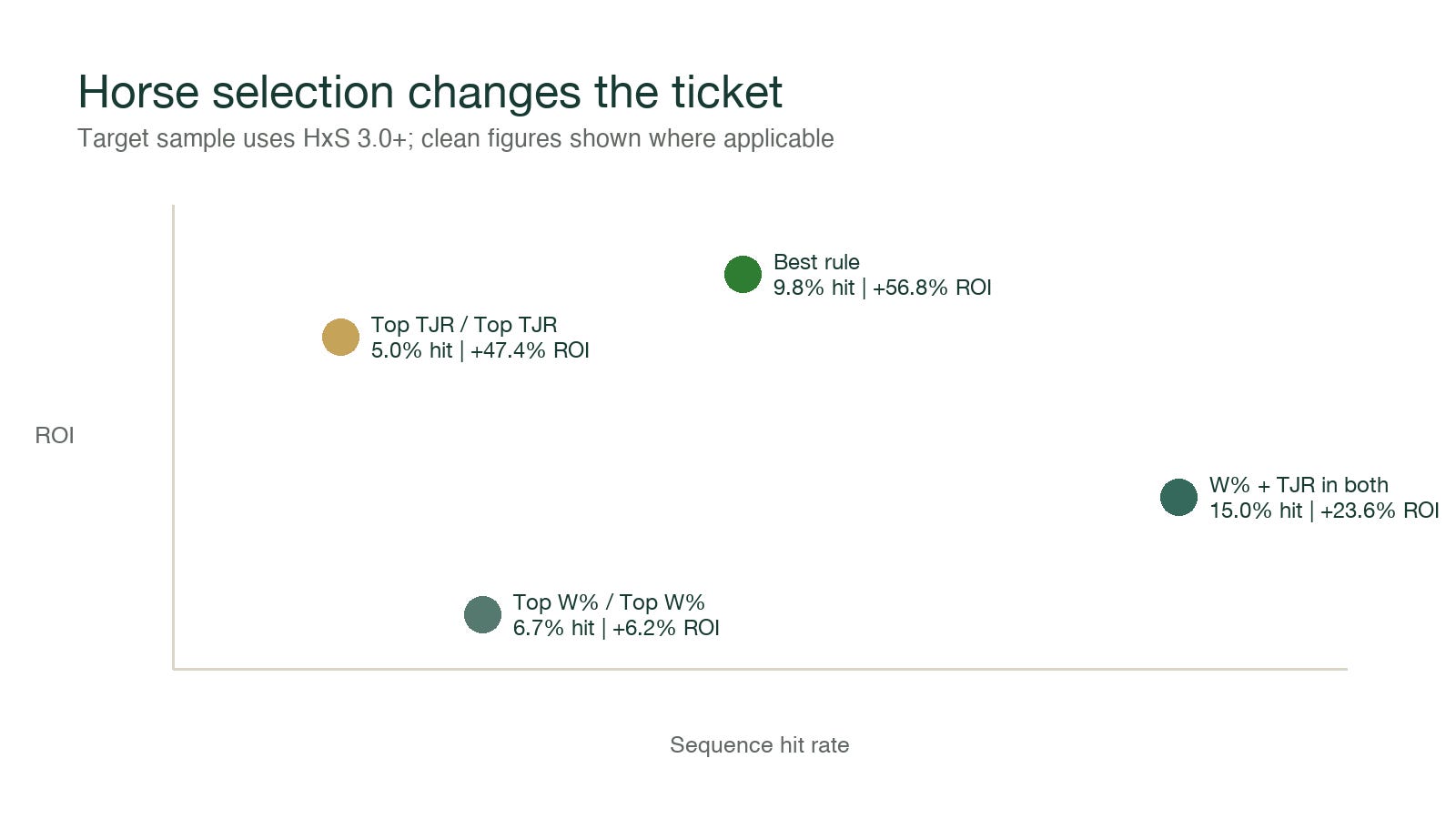
| Top W% in both legs | 6.7% | +6.2% | +3.4% | +9.2% |
| Top TJR in both legs | 5.0% | +47.4% | +72.8% | +19.1% |
The Trainer Jockey Rating, or TJR, found less obvious combinations with much higher returns, but it also lowered the hit rate. That led to a more practical question: could we use TJR for price while preserving W% coverage?
For the 782 sequences in which both races were clean and HxS was at least 3.0, including both the top-W% horse and top-TJR horse in both races produced:
| Coverage Alternative | Sequences | Hit Rate | Avg Combinations | ROI | Early ROI | Holdout ROI |
|---|---|---|---|---|---|---|
| Top W% + Top TJR in both legs | 782 | 15.0% | 2.77 | +23.6% | +25.5% | +21.4% |
That is worth mentioning. It delivered the highest practical hit rate and stayed profitable in both periods. The tradeoff is ticket size. Using both horses in both legs can require four combinations, although overlap between the top W% and top TJR reduced the historical average to 2.77.
The best current rule
The strongest balance came from letting CONF decide where to anchor and where to spread.
- Require both races to have HxS of 3.0 or higher.
- Require both races to have a clean condition.
- In the race with the higher CONF, single the horse with the highest TJR.
- In the other race, use the horse with the highest W% and the horse with the highest TJR.
- If the same horse leads both W% and TJR, use that horse once.
| Best Current Rule | Sequences | Hit Rate | Avg Combinations | ROI | Early ROI | Holdout ROI |
|---|---|---|---|---|---|---|
| Higher-CONF TJR anchor and W% plus TJR coverage | 782 | 9.8% | 1.70 | +56.8% | +60.1% | +52.9% |
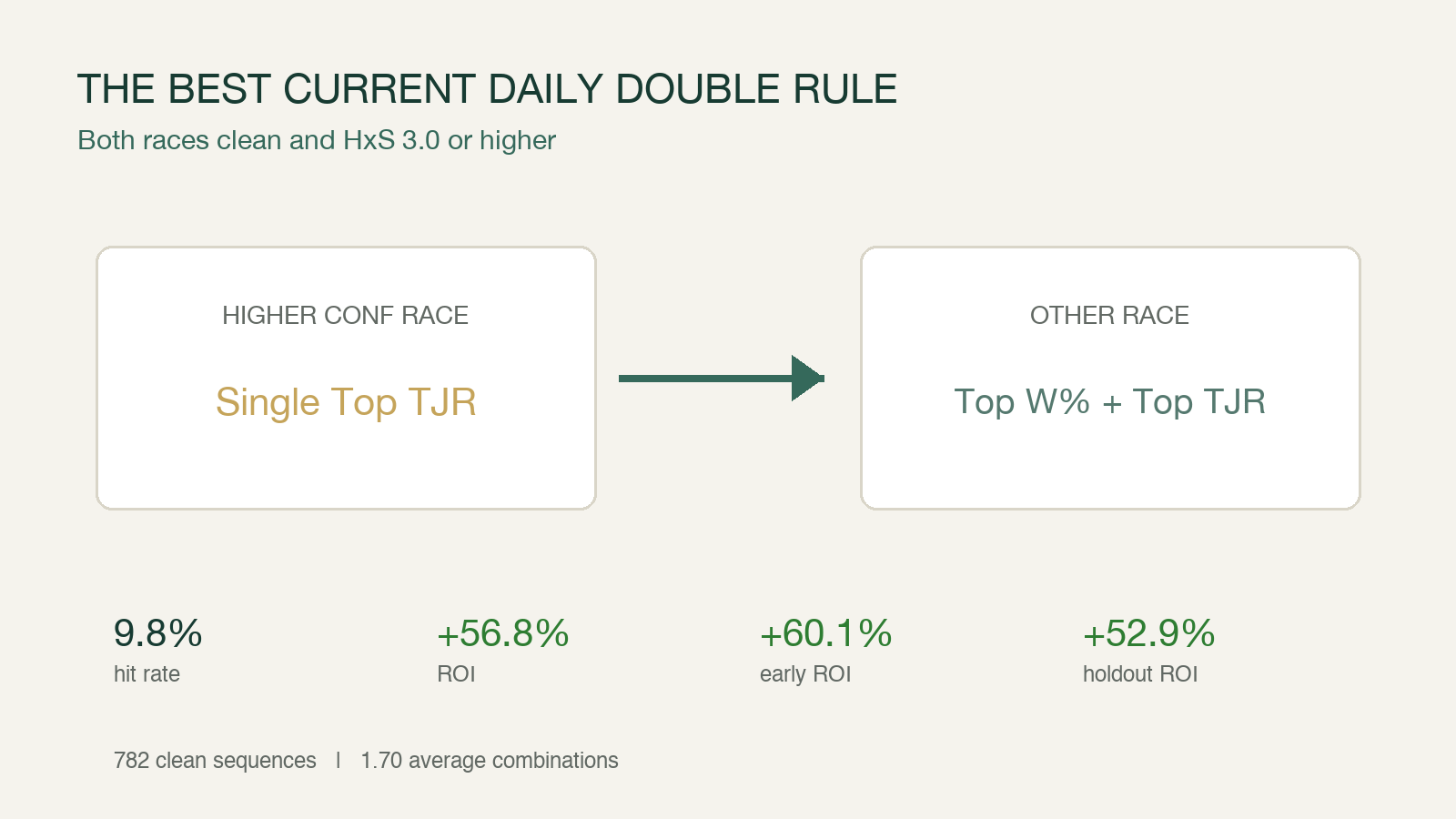
The early and holdout results both remained strong, and the rule worked across the full group of tracks in the database. It also stayed economical, averaging only 1.70 combinations per sequence.
This is intentionally a strict rule. It can be applied consistently, but it should never replace judgment. Customers should still handicap both races thoroughly, account for scratches, confirm surface and distance, evaluate pace, consider current prices, and pass when the race does not make sense. The rule narrows the wagering menu. It does not put handicapping on autopilot.
What clean condition means
For this analysis, a race is clean only when:
- a dirt race is listed FAST, or a turf race is listed FIRM;
- the condition does not carry an asterisk indicating a surface change; and
- the final scratches and race changes have been incorporated.
A blank condition can qualify provisionally before wagering, but the sequence should not be played until both legs are confirmed clean. If either race changes surface or receives a non-clean condition, the wager is removed.
A live example from September 16
The rule identified four doubles after clean-condition confirmation.
At Finger Lakes, #3 Lady Serenity won Race 7 and #8 Valiant Warrior won Race 8. The 3-8 Daily Double paid $44.44 for $2.
The four recommendations required six $2 combinations. That meant $12 wagered and $44.44 returned, a 25% sequence hit rate and +270.3% ROI.
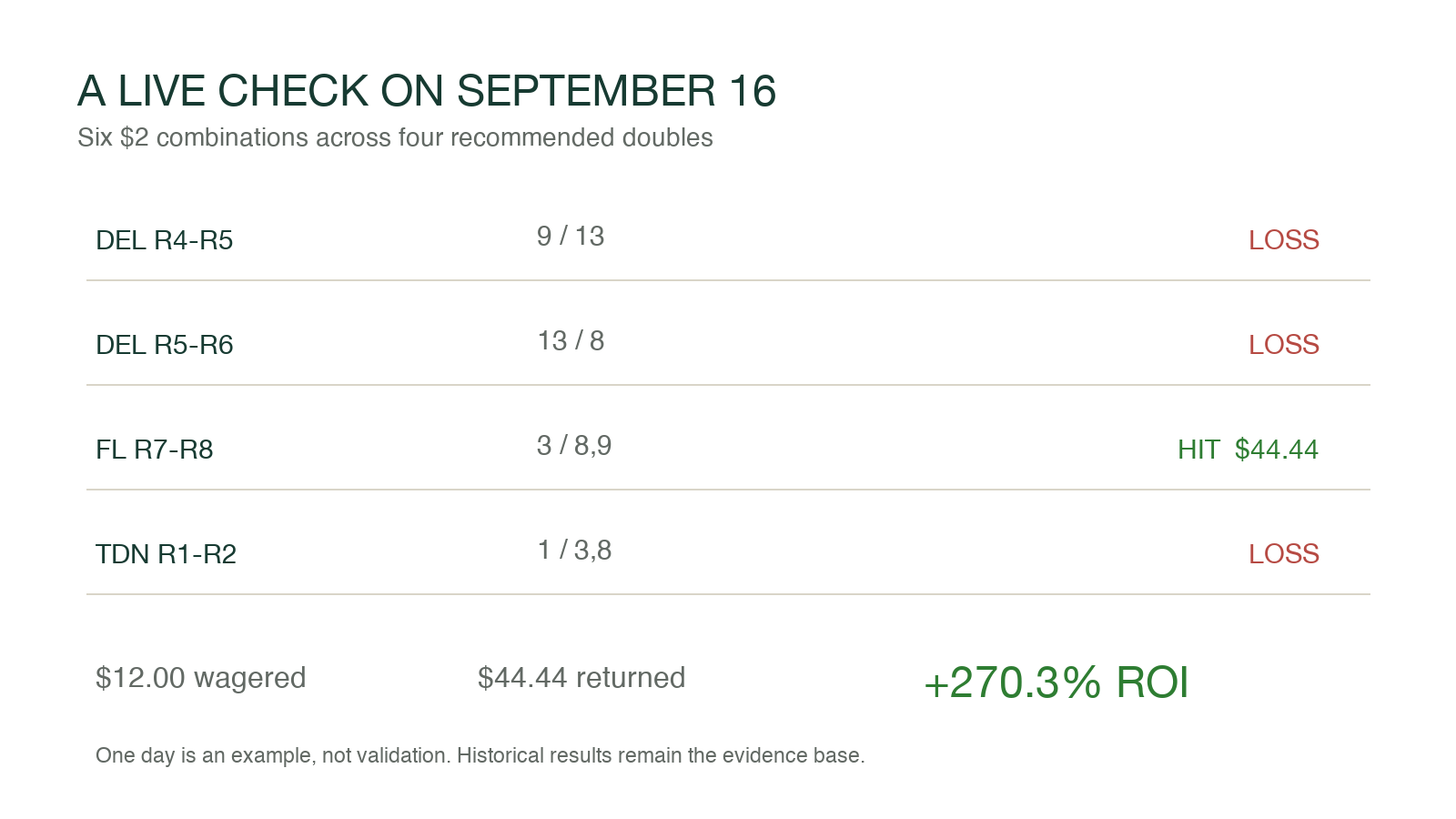
That was a satisfying live result, particularly because the Finger Lakes ticket used the higher-CONF TJR anchor exactly as designed. It is still only one day. The historical sample and the later holdout period are the evidence; a single winning afternoon is an illustration.
The lesson
The best Daily Double opportunity did not come from finding the two most likely winners and linking them. It came from a sequence of decisions:
- Decide whether the two races deserve a wager.
- Demand adequate HxS in both legs.
- Wait for clean conditions.
- Use TJR to find a less obvious anchor where confidence is stronger.
- Preserve W% and TJR coverage in the more uncertain race.
- Keep the ticket compact.
- Handicap the races before committing money.
That is a much narrower approach than playing every available double. It is supposed to be.
Continue with Charting Horse Value
Subscribe free or paid using the Subscribe option on this Substack to receive new research, race analysis, and model updates. A paid Substack subscription includes full access to the Charting Horse Value app.
You can also explore Charting Horse Value through the CHV app and review the available app and report options.
To learn the model and use the reports more effectively:
- Watch the Tutorial Videos.
- Use the CHV Glossary.
- Read additional CHV Insights.
No handicapping method guarantees a winner or a profit. Historical ROI does not guarantee future results. Wager only what you can afford to lose.