
The most useful handicapping question is not always, “Who is going to win?”
Sometimes it is, “Which race should I study first?”
That was the starting point on Sunday, September 20, 2026. In the Charting Horse Value app, I searched every track and ranked the races by Both, the sum of the Horizontal Exotic Score (HxS) and Single Exotic Score (1xS).
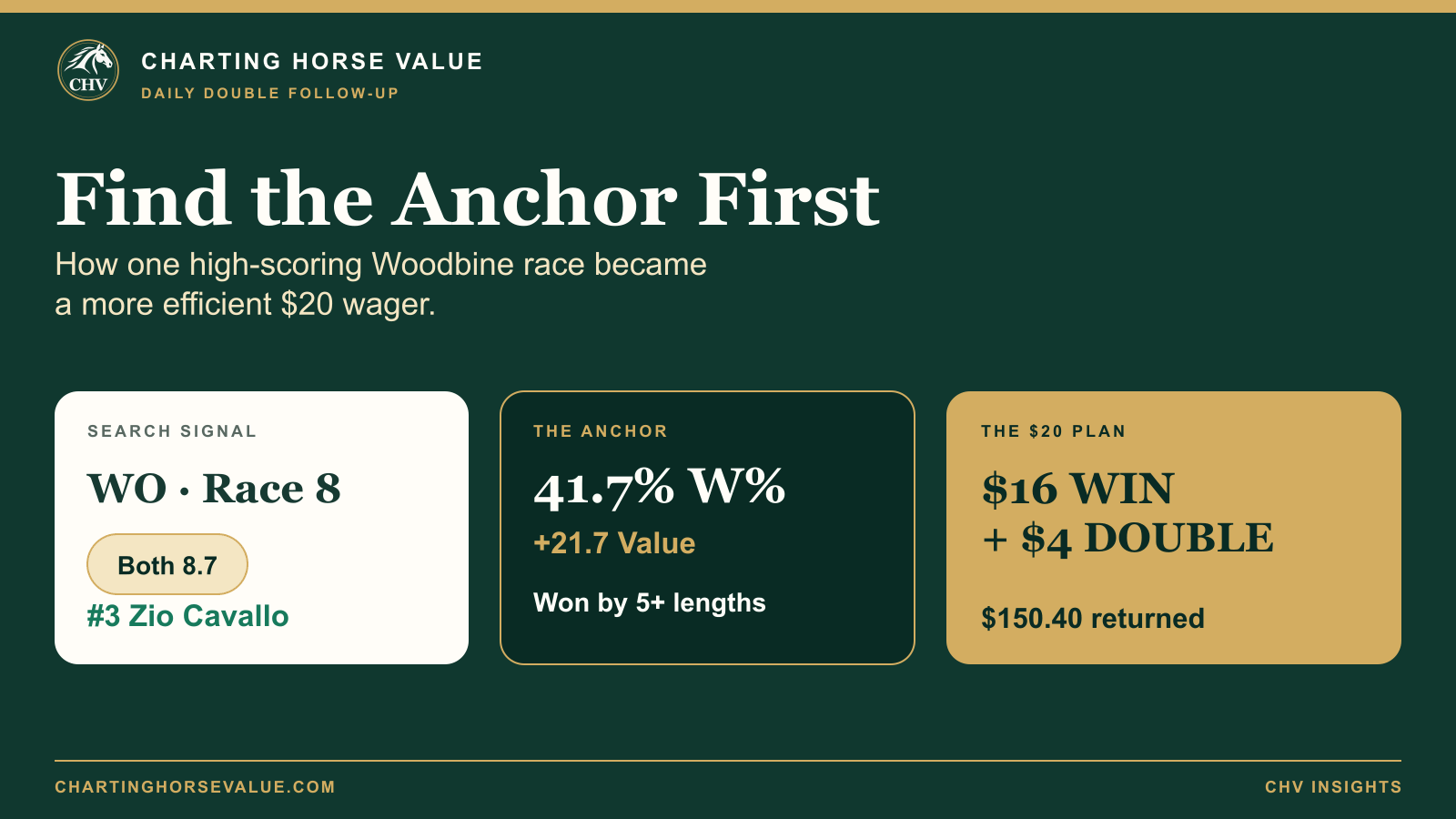
Woodbine Race 8 rose to the top with a combined score of 8.7. Churchill Downs Race 5 followed at 7.6.
Those scores did not make the selections for me. They did something just as important: they narrowed 118 available races to the places where deeper work was most likely to pay.
Why search by Both?
HxS and 1xS answer different questions.
- HxS measures whether a race has the ingredients for an attractive horizontal wager: favorite vulnerability, credible alternatives and price potential.
- 1xS measures whether the race offers a horse strong enough to use as a primary anchor or single.
Selecting Both adds the two scores and ranks the races with the strongest combined case. A high score can therefore point to a productive overlap: a race with enough separation to identify a key horse and enough wagering potential to use that horse beyond the win pool.
The first two races on the September 20 list produced exactly that kind of signal.
At Churchill Downs, #9 East Village won Race 5 at nearly 5–2 and paid $6.86.
At Woodbine, #3 Zio Cavallo won Race 8 at nearly 4–1 and paid $9.80.
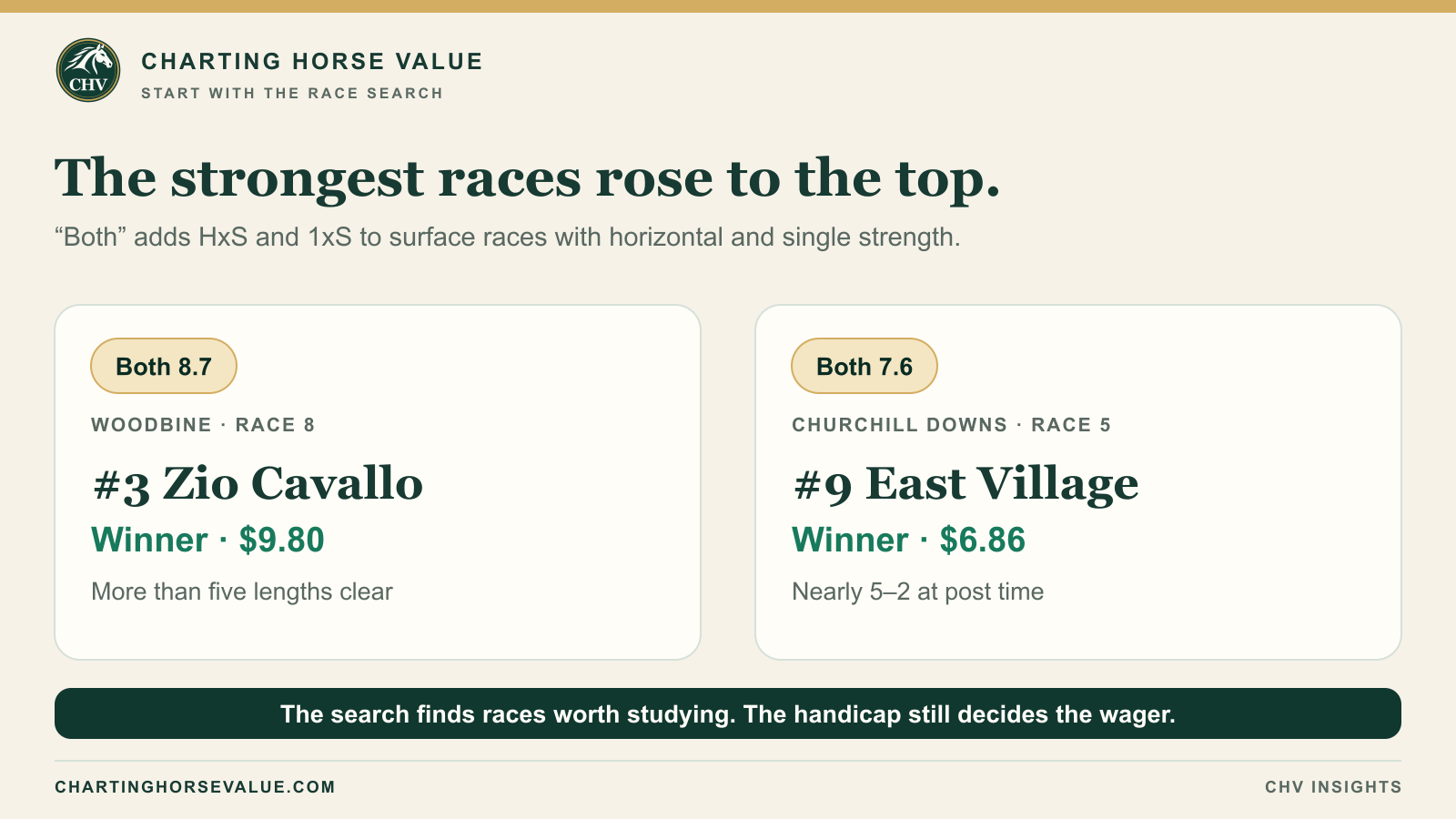
The point is not that every high-scoring race will produce the top CHV horse as the winner. No score can promise that. The value of the search is triage: it tells us where to spend our limited handicapping time.
Why Zio Cavallo was the anchor
Once Woodbine Race 8 reached the top of the list, the individual horse analysis made the case unusually clear.
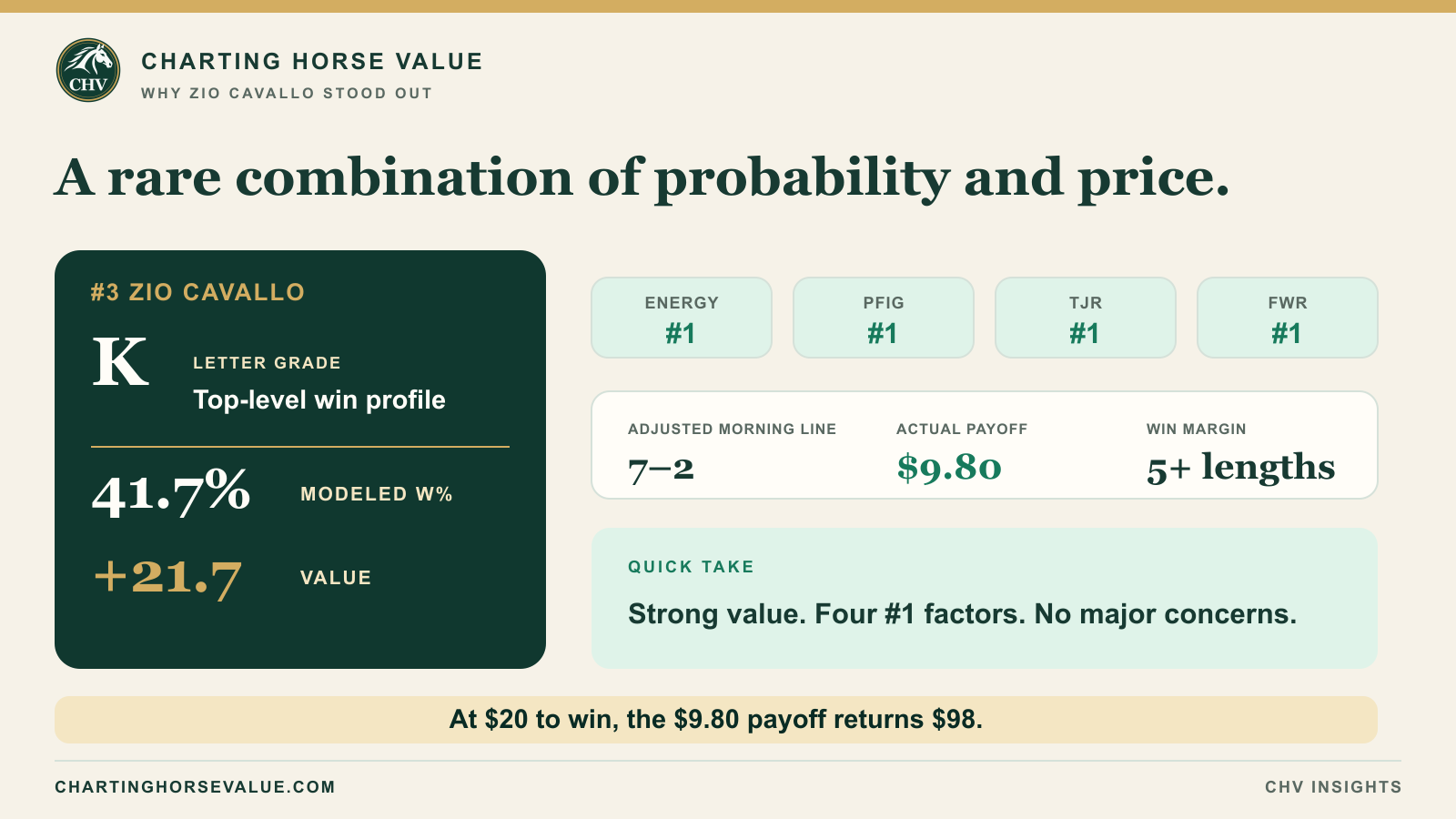
Zio Cavallo carried a K letter grade and a 41.7% modeled win probability, the highest in the field. His displayed morning line was 7–2, yet CHV showed +21.7 Value. He ranked first in:
- Energy (ENY)
- Performance Figure (PFIG)
- Trainer Jockey Rating (TJR)
- Fitness Workout Rating (FWR)
The report’s Quick Take identified strong value and no major concerns. This was not a horse supported by one isolated angle. The probability, price and supporting factors all pointed in the same direction.
That is the kind of horse I want to press when the final odds remain attractive.
The market sent Zio Cavallo off at nearly 4–1. He won by more than five lengths and paid $9.80. A $20 win bet returned $98.
That would have been a very good result by itself. But the high HxS score suggested another question: could this strong anchor improve the way we played the next race?
Turning the anchor into a Daily Double
For the Daily Double, I narrowed the search to Woodbine and ranked the races by HxS.
Woodbine Race 8 had an HxS of 4.3. Race 9 followed with an HxS of 3.7. Both cleared the 3.0 threshold from the Daily Double research, making the 8–9 sequence worth examining more closely, assuming the conditions remained clean.
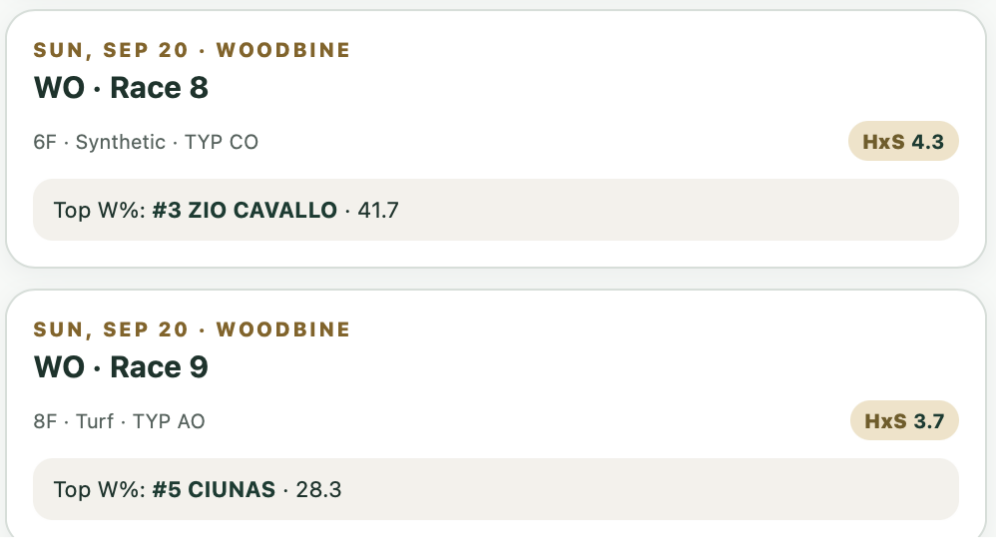
The research rule pointed to two Race 9 horses:
- #5 Ciunas, the top modeled W% horse
- #3 Eyes on the King, the top TJR horse
But a rule identifies candidates. It does not eliminate handicapping judgment.
Eyes on the King was returning from a 396-day layoff and carried –22.7 Value. I did not want to use him simply because he led TJR. That left Ciunas as the horse I wanted in the second leg.
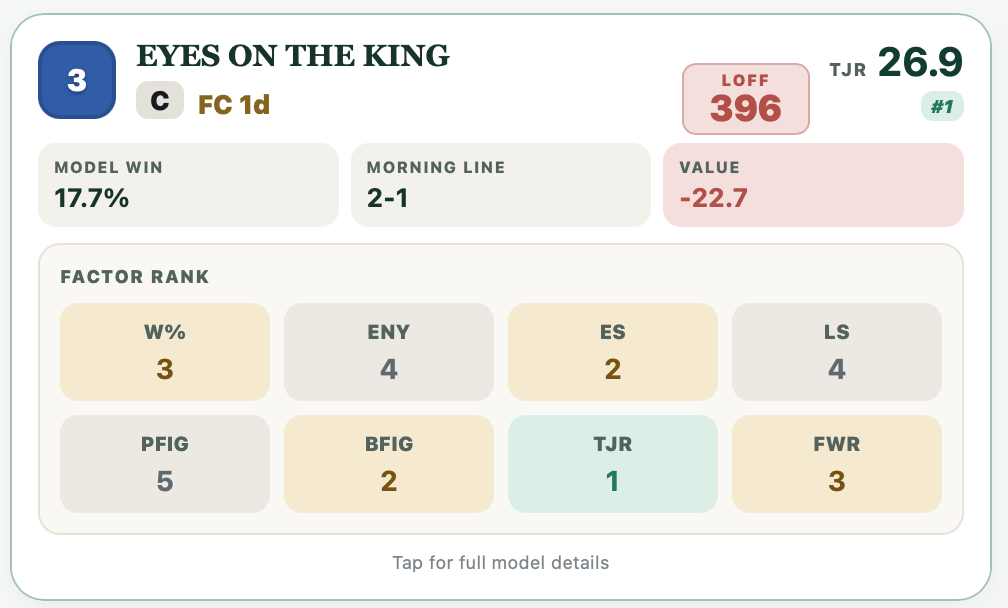
Instead of spreading to both Race 9 qualifiers, the final opinion became an ice-cold 3–5 Daily Double: Zio Cavallo to Ciunas.
The $20 decision
Suppose the original plan was to bet $20 to win on each horse.
Zio Cavallo’s $9.80 payoff would return $98 on a $20 win bet. Ciunas went off at 1.75–1, so a $20 win bet would return $55. If both won, the two separate bets would return $153 from $40 staked.
There was a more capital-efficient way to express the same opinion:
| Wager | Stake | Return if successful |
|---|---|---|
| #3 Zio Cavallo to win | $16 | $78.40 |
| 3–5 Daily Double | $4 | $72.00 |
| Total | $20 | $150.40 |
The posted Daily Double payoff was $18 for $1, so the $4 double returned $72. Add the $78.40 from the win bet and the total return was $150.40.
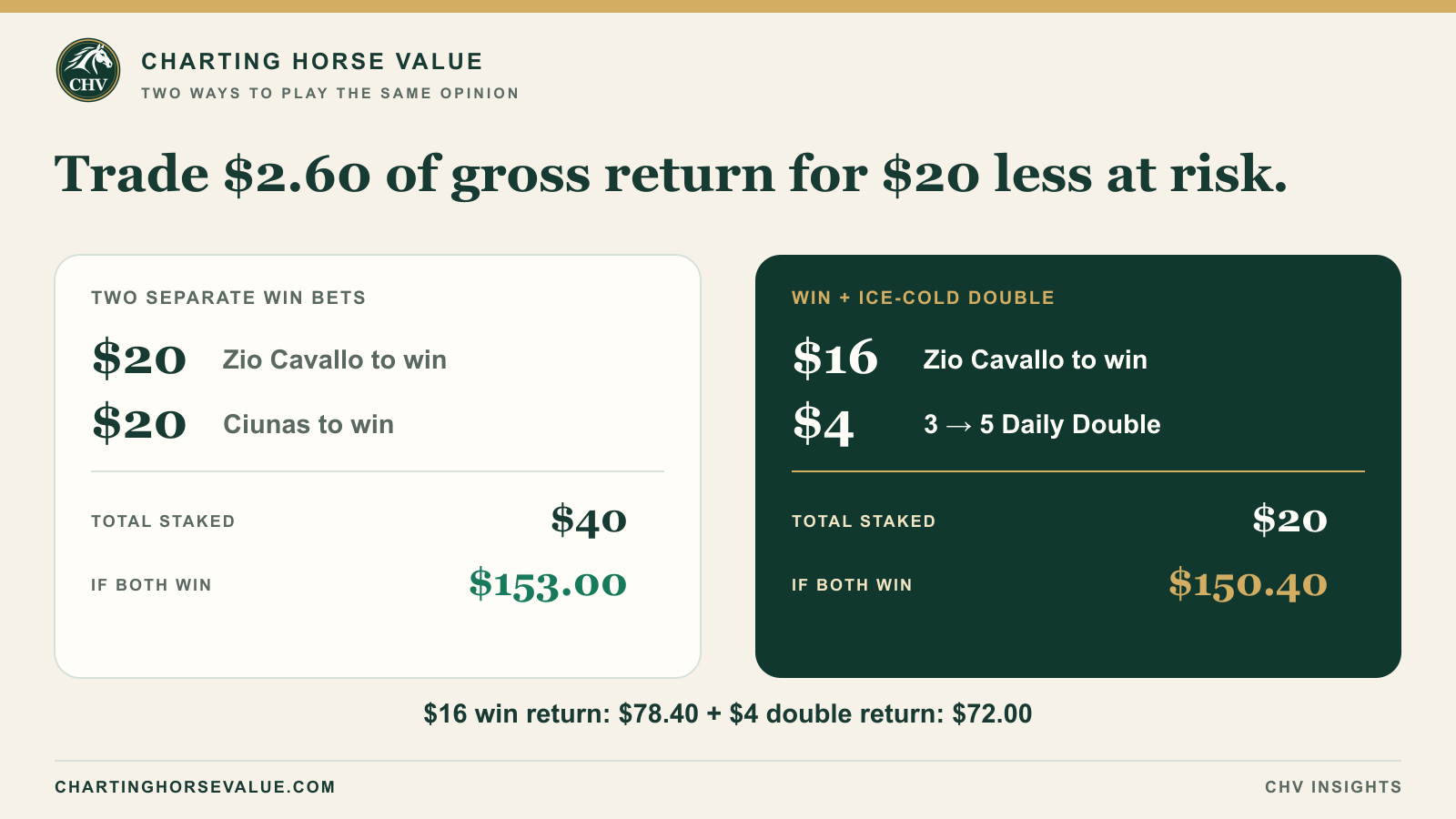
The gross return was only $2.60 below the $153 generated by two separate $20 win bets, but the total stake fell from $40 to $20.
The structure also changed the risk path:
- If Zio Cavallo lost, the entire loss was capped at the original $20.
- If Zio won but Ciunas lost, the $16 win bet still returned $78.40.
- If both won, the combined return was $150.40.
This is the practical appeal of the Daily Double. We used the strongest opinion as both a win bet and the first leg of a compact parlay. We did not need to commit a second $20 after Race 8.
I would describe this as capital efficiency, rather than claiming that the statutory takeout rate changed. The win and Daily Double pools each have their own takeout and their own prices. What improved here was the relationship between dollars committed and potential return.
The research still matters
This example began with the more selective Daily Double framework introduced last week:
- Require both races to have HxS of 3.0 or higher.
- Require clean conditions in both legs.
- Use CONF to decide where to anchor and where to spread.
- Incorporate both modeled W% and TJR when constructing the ticket.
The strict historical rule produced a +56.8% ROI across 782 qualifying sequences, with a 9.8% hit rate and an average of 1.70 combinations.
The more conservative alternative—covering the top W% and top TJR horse in both legs—produced a higher 15.0% hit rate and a +23.6% ROI. It averaged 2.77 combinations because the same horse sometimes led both measures.
That second approach is useful for players who value more coverage and a steadier hit rate, even if it sacrifices some historical ROI.
On September 20, applying that conservative coverage approach across all tracks produced six qualifying Daily Double sequences. Covering them required 18 one-dollar combinations, or $18 wagered. The return was $28.10, a profit of $10.10 and a +56.1% ROI for the day.
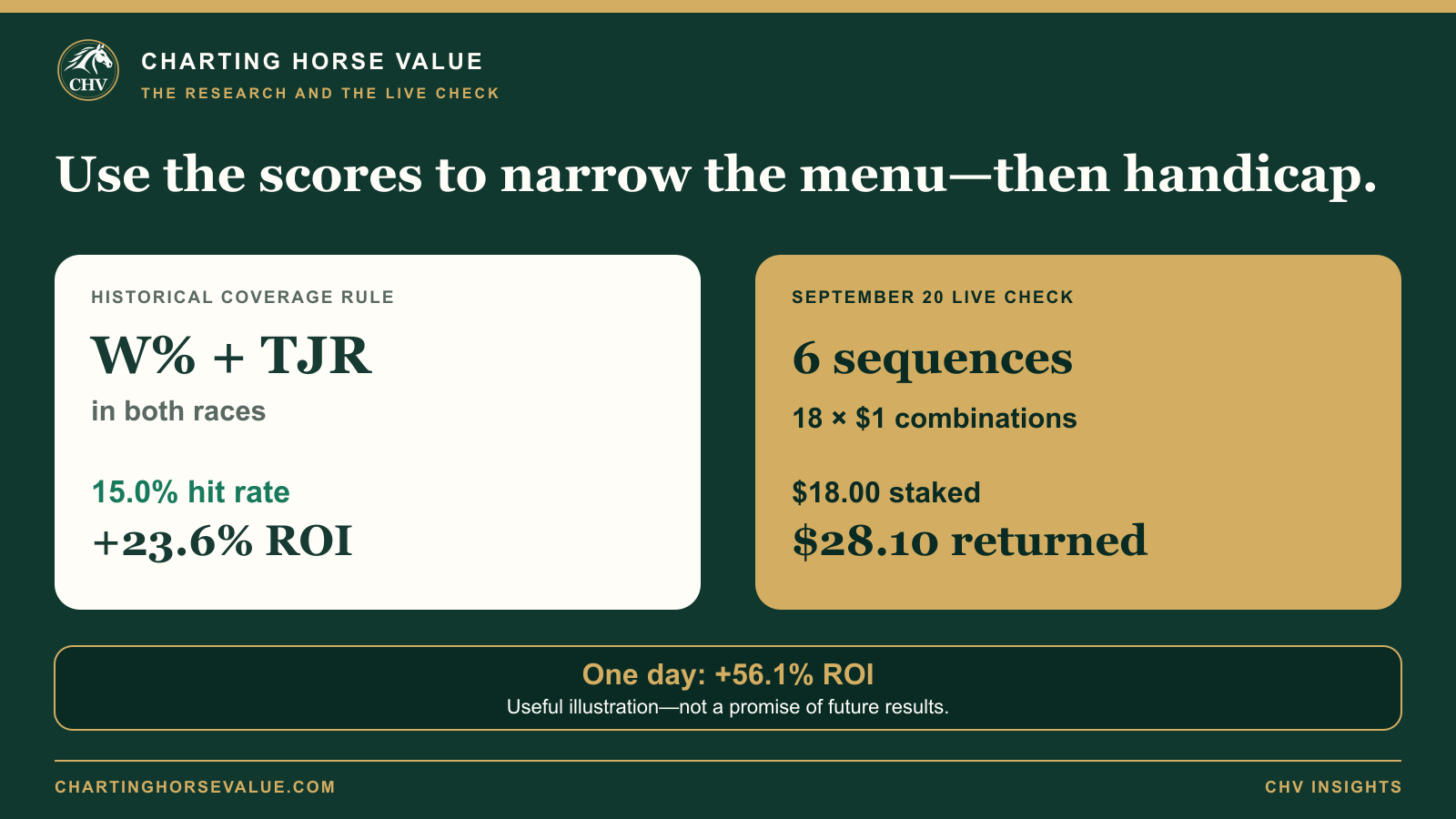
One profitable day is an illustration, not proof. The larger historical sample and the holdout results are the evidence. Daily results will vary, and even a sound method will experience losing days and losing streaks.
The real lesson
The best use of the CHV search was not to generate a long list of automatic bets. It created a better decision sequence:
- Find the races worth studying. The combined HxS + 1xS search placed Woodbine Race 8 and Churchill Downs Race 5 at the top.
- Identify the anchor. Zio Cavallo combined a K grade, 41.7% modeled win probability, +21.7 Value and broad factor support.
- Test the adjacent race. Woodbine Race 9 also cleared the HxS threshold.
- Apply judgment to the candidates. The 396-day layoff and negative Value made Eyes on the King unattractive despite the top TJR rank.
- Choose the most efficient expression of the opinion. A $16 win bet plus a $4 ice-cold double created nearly the same gross return as two $20 win bets while cutting the total stake in half.
That is what good wagering construction should do. The handicapping finds the opinion. The ticket determines how efficiently we get paid when the opinion is right.
Continue with Charting Horse Value
Use the Search feature in the CHV app to rank races by HxS, 1xS or Both, then open the leading races and handicap the individual horses before committing money.
Subscribe free or paid through CHV’s Substack to receive future research, live examples and model updates. A paid monthly or annual subscription includes full access to the Charting Horse Value app.
You can also:
- Explore the CHV app.
- Review app access and report options.
- Watch the tutorial videos.
- Use the CHV Glossary.
- Read more CHV Insights.
No handicapping method guarantees a winner or a profit. Historical ROI and individual race examples do not guarantee future results. Wager only what you can afford to lose.