
Reading Form Cycles: What CHV’s FC Combinations Reveal About Readiness and Value

Form Cycle codes describe where a horse stands today. When several codes appear together, they can reveal improvement patterns that the betting market has historically underpriced.
CHV Analysis
This review uses exact normalized Form Cycle combinations for Thoroughbreds. It compares current Green FC combinations across all conditions, then separates clean races—FAST dirt or FIRM turf without a surface change indicated by an asterisk—from all other conditions. ROI represents the historical return from a $2 win wager on every qualifying starter. The results describe past groups, not guaranteed outcomes for an individual horse.
Form is not a fixed rating. A horse can improve because it is returning from a layoff, progressing through its first few career starts, changing barns, dropping in class, returning to a preferred surface, or racing for a productive trainer-jockey team.
Charting Horse Value captures those situations with Form Cycle (FC) codes. One code describes one circumstance. A combination of codes describes several circumstances occurring at the same time.
Start by decoding the FC codes
- 1L / 2L / 3L — first, second, or third lifetime start.
- 1 / 2 / 3 — first, second, or third start after a layoff of at least 90 days.
- C1 / C2 / C3 — first, second, or third start after a claim.
- tj — a historically profitable trainer-jockey combination angle.
- d — dropping in class.
- sr — surface rebound: eligible to improve when returning to a preferred surface.
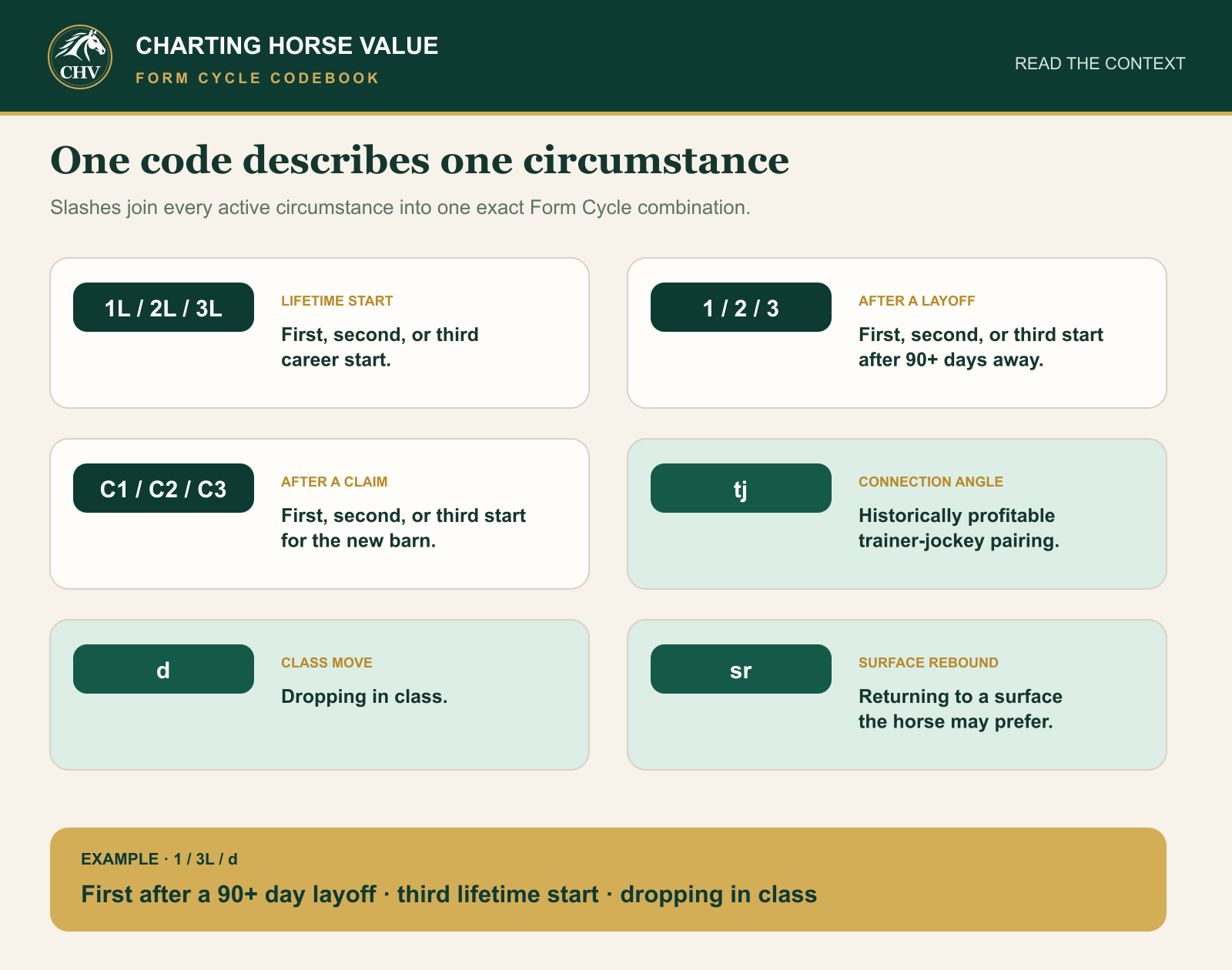
Slashes join multiple active codes into one exact combination. For example, 1/3L/d identifies a horse making its first start after a 90-day-or-longer layoff, its third lifetime start, and a class drop. The combination is more specific than any one of those facts by itself.
FC codes are context, not a prediction that replaces modeled win probability. They explain why a horse may be positioned to improve. W%, fair odds, Value, pace, and the rest of the handicap factors still determine whether that horse belongs in the wager.
What a Green FC combination means
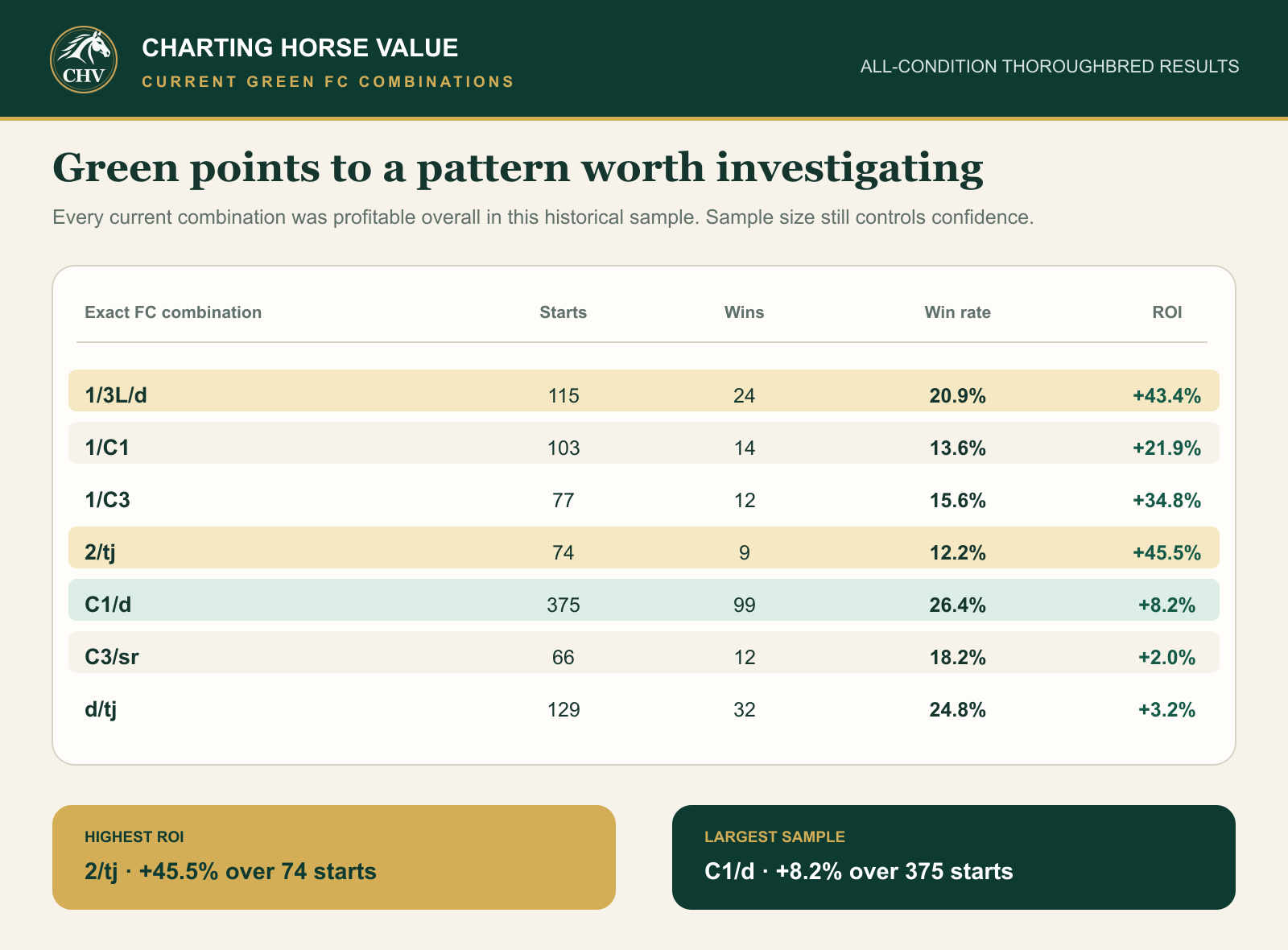
CHV displays selected combinations in green when their historical performance has supported extra attention. The current list includes 1/3L/d, 1/C1, 1/C3, 2/tj, C1/d, C3/sr, and d/tj.
Across all conditions, every combination on the current list produced a positive historical ROI in this sample. The strongest returns came from 2/tj (+45.5%), 1/3L/d (+43.4%), and 1/C3 (+34.8%). Those percentages are striking, but the underlying groups contained only 74, 115, and 77 starts. They deserve attention, not blind wagering.
The largest sample belonged to C1/d. Horses making their first start after a claim while dropping in class won 26.4% of 375 starts and returned +8.2% ROI. That lower return is supported by substantially more observations, which makes it especially useful as a reference point.
Clean conditions reveal the strongest current signals
Separating clean from non-clean races shows that surface condition can change the meaning of a Form Cycle combination.
Three current Green combinations produced the strongest clean-condition returns:
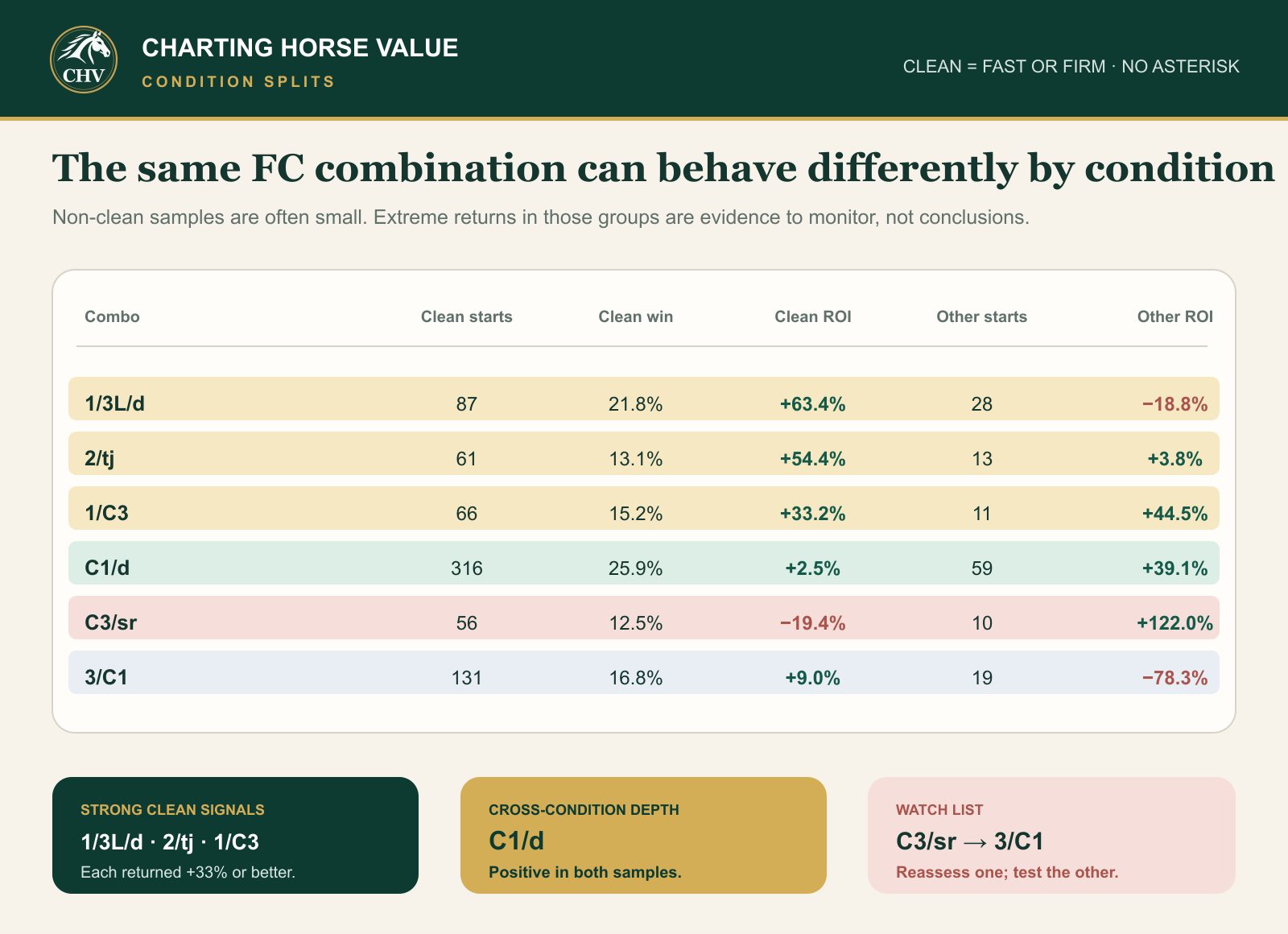
- 1/3L/d — 87 starts, 21.8% wins, +63.4% ROI.
- 2/tj — 61 starts, 13.1% wins, +54.4% ROI.
- 1/C3 — 66 starts, 15.2% wins, +33.2% ROI.
The cleaner evidence does not simply reward high win rates. The 2/tj group won only 13.1%, yet its winners paid enough to produce the second-best return. That is the difference between a useful handicapping angle and an obvious favorite-producing angle.
C1/d had the most dependable cross-condition profile. Its 316 clean starts produced a 25.9% win rate and +2.5% ROI. Its 59 non-clean starts produced a 28.8% win rate and +39.1% ROI. It is the only current combination with meaningful volume and positive returns in both groups.
One Green combination now deserves another look
C3/sr remained slightly profitable when all conditions were combined: 66 starts, an 18.2% win rate, and +2.0% ROI. The clean-condition view was much weaker—56 starts, a 12.5% win rate, and –19.4% ROI.
Its non-clean group returned +122.0%, but that result came from only 10 starts. A handful of outcomes can dominate a sample that small. The non-clean result is not strong enough to offset the clean evidence or confirm that the angle is durable.
That does not make every C3/sr horse a poor wager. It means the combination is no longer supporting its Green designation as convincingly as the other codes. CHV will continue to monitor it as the sample grows.
A possible clean-only candidate
Among the combinations that are not currently Green, 3/C1 stood out. Horses making their third start after a layoff and their first start after a claim went 22-for-131 in clean conditions: a 16.8% win rate and +9.0% ROI.
It is the only non-Green combination in this review with at least 50 clean starts and a positive clean-condition ROI. Its 19 non-clean starts returned –78.3%, so the evidence does not support a broad all-condition designation. It may be a candidate for a clean-only Green signal if future results confirm the pattern.
The rest of the leading non-Green combinations reinforce the need for selectivity. Several had respectable win rates, but none of the other groups with at least 50 clean starts produced a positive clean ROI. A plausible story is not enough; the price and the historical return still matter.
What the results tell us
The current evidence leads to five practical conclusions:
- Exact combinations matter. A code should be evaluated as part of the complete FC string, not treated as interchangeable with every combination containing that code.
- Track condition can change the result. Clean and non-clean samples should not be blended without checking whether they tell the same story.
- Sample size changes confidence. C1/d has hundreds of starts; many non-clean groups have fewer than 20. Their ROI percentages do not deserve equal weight.
- Win rate and ROI answer different questions. A low-frequency combination can be profitable when the winners are underbet, while a high win rate can still be fully priced.
- Green is a research signal, not an automatic wager. Use the code to investigate the horse, then let probability, fair odds, Value, and race structure decide the bet.
How to find Green FC combinations in the CHV app
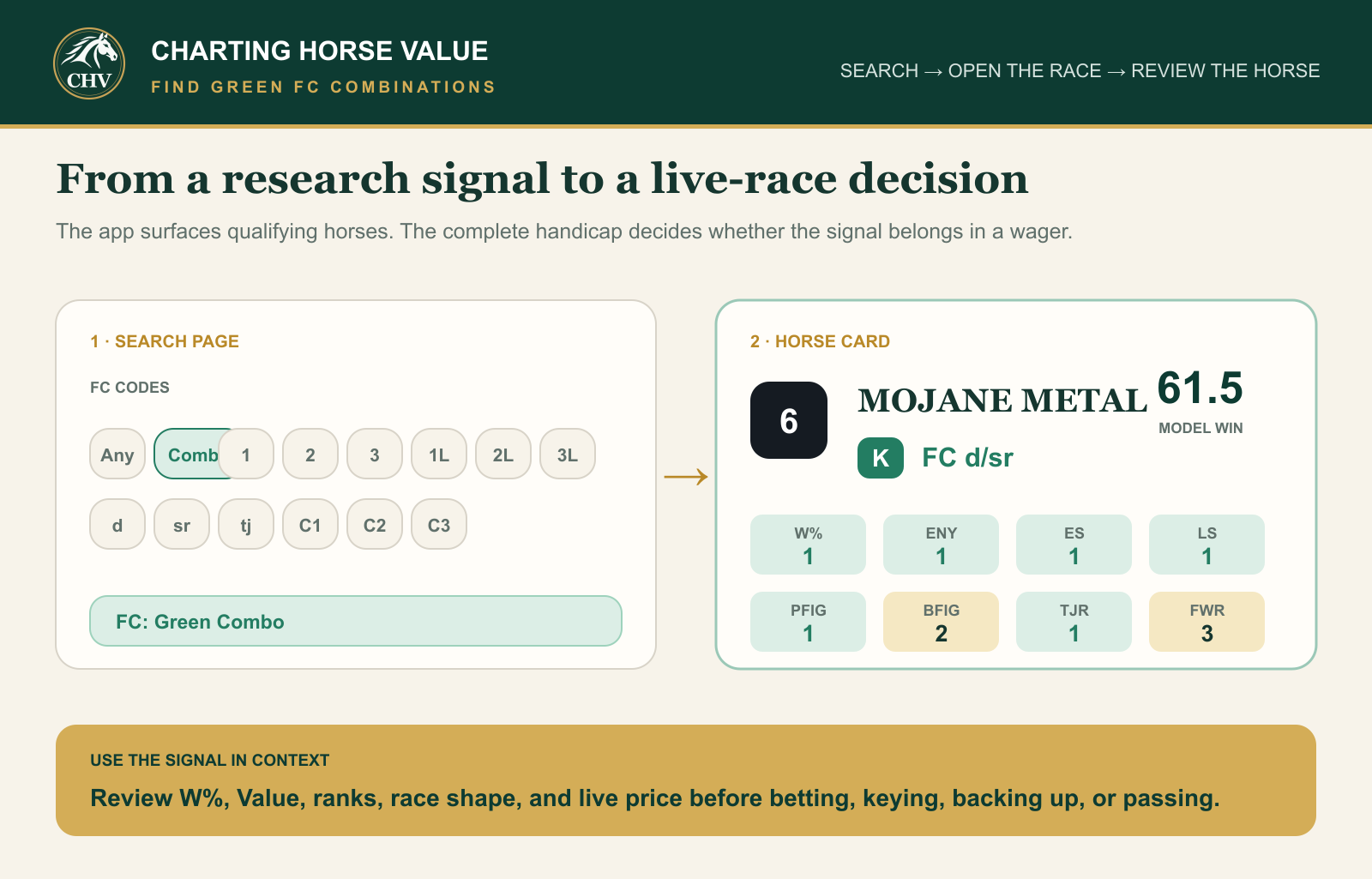
On the Search page, select Combo under FC Codes. The results show races containing at least one horse with a current Green FC combination. Open the race and look for the horse's FC string beside its letter grade; qualifying combinations appear in green.
The search is a fast way to build a focused list. It does not replace the final handicapping analysis. Review the horse's W%, Value, factor ranks, layoff or claim context, and the live price before deciding whether to bet, use the horse in exotics, or pass.
The Green list will continue to change
Form Cycle research is not a one-time exercise. New races add evidence, market behavior changes, and some combinations strengthen while others weaken. CHV will continue to monitor every FC code and exact combination for win rate, ROI, condition sensitivity, and adequate sample size.
The Green FC combination list will be updated when the evidence supports a change. That may mean adding a new signal such as 3/C1 for clean races, narrowing an existing signal to specific conditions, or removing a combination that no longer demonstrates a durable advantage.
Related CHV resources
- Review every CHV factor and abbreviation
- Read the Key Factor ROI analysis
- See how CHV letter grades represent modeled win probability
- Watch CHV tutorial videos
- Compare the mobile app and Handicap Report
Continue your CHV journey
Use the CHV app to search for current Green FC combinations, open the qualifying races, and place each signal inside the complete handicap. Form Cycle explains where improvement may come from. Modeled probability estimates the chance of winning. Price determines whether the opportunity belongs in your wager.